Travel Adapter and Voltage Guide: How to Charge Devices Safely Abroad
A travel adapter and voltage guide is the first thing an international traveler should read before plugging anything into a foreign wall socket. Voltage standards, plug shapes, and frequency vary by country, and connecting the wrong device to the wrong outlet can destroy electronics, trigger safety hazards, or leave you without essential gear in the middle of a trip. This guide explains how electrical systems differ around the world, how to identify what your devices actually need, which adapters and converters you need to bring, and how to charge everything safely no matter where you travel.
Why Electrical Standards Differ Around the World
There is no single global electrical standard. Countries independently developed their power infrastructure during the late 19th and early 20th centuries, adopting different voltages, frequencies, and plug configurations based on local engineering decisions at the time. Those choices became deeply embedded in infrastructure, making universal standardization impractical to retrofit.
Today, two broad voltage families exist:
- 110–120 volts – Used primarily in North America, Central America, and parts of South America and the Caribbean. The United States and Canada operate at 120V, 60Hz.
- 220–240 volts – Used across Europe, the United Kingdom, Australia, most of Asia, Africa, and much of South America. Most European countries operate at 230V, 50Hz.
The frequency difference (50Hz vs. 60Hz) is usually irrelevant for modern consumer electronics but can matter for certain older or motor-driven appliances such as clocks, turntables, or some power tools.
Understanding the Difference Between a Travel Adapter and a Voltage Converter
These two terms are not interchangeable, yet they are frequently confused. Getting this distinction right is the most important part of the entire voltage guide.
What a Travel Adapter Does
A travel adapter changes the physical shape of a plug so it can fit into a foreign outlet. It does nothing to the electricity itself. It does not change voltage, current, or frequency. If you plug a 120V device into a 240V outlet through an adapter only, the device will receive twice the voltage it was designed for. This can destroy the device instantly, cause it to overheat, or in rare cases create a fire or shock hazard.
What a Voltage Converter Does
A voltage converter (also called a transformer or voltage regulator) steps the electrical voltage up or down to match what a device requires. A traveler going from the US to Europe might carry a step-down converter that reduces 230V to 120V for devices that can only handle 120V input. Converters are heavier, bulkier, and more expensive than adapters—and most modern travelers do not need them, for reasons explained in the next section.
Dual-Voltage Devices: Why Most Modern Electronics Do Not Need a Converter
Most consumer electronics manufactured in the last 15 years are designed as dual-voltage or universal-voltage devices. This includes smartphones, laptops, tablets, e-readers, camera battery chargers, and most USB charging bricks. A dual-voltage device can automatically accept any input voltage between 100V and 240V and any frequency between 50Hz and 60Hz.
To check whether a device is dual-voltage, look at the small text printed on the power adapter or charging brick. It will show an input range such as:
- Input: 100-240V ~ 50/60Hz – This is a universal-voltage device. It needs only a plug adapter abroad, not a converter.
- Input: 120V ~ 60Hz – This is a single-voltage device designed for North American current. Using it abroad at 230V without a converter will damage or destroy it.
Always check this label before assuming a device is safe. Do not guess. The label is typically found on the power brick itself, not on the device.
Common Single-Voltage Devices That May Require a Converter
- Hair dryers and curling irons rated for 120V only (the most commonly damaged travel appliances)
- Electric shavers without dual-voltage labeling
- Older alarm clocks, especially analog models
- Some kitchen appliances brought for extended stays
The practical solution for hair dryers and styling tools is to buy a dual-voltage version before traveling, rather than carrying a heavy converter. Travel-specific dual-voltage hair dryers are widely available and typically compact enough to pack easily.
Plug Types Around the World
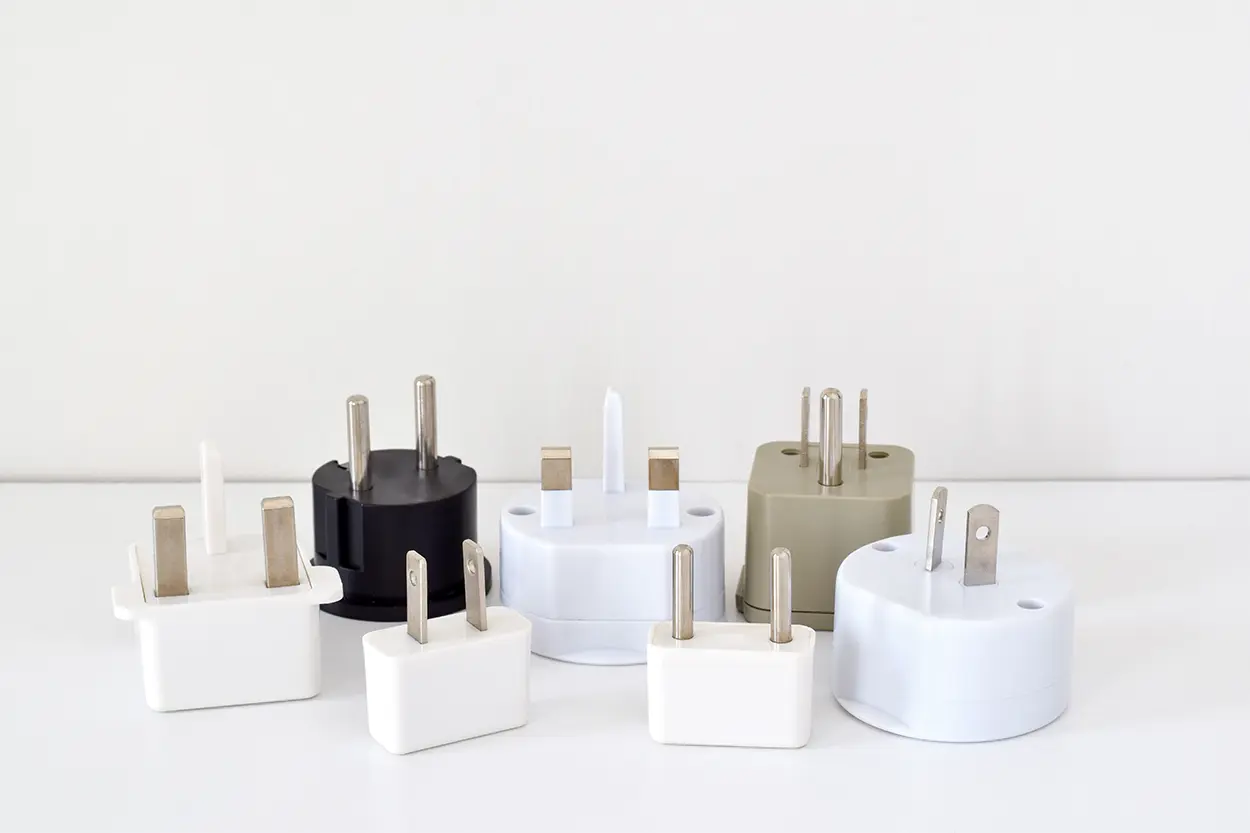
Even if voltage is not an issue, the physical plug shape determines which adapter you need. The International Electrotechnical Commission (IEC) maintains the global catalog of plug and socket types, typically designated by letters A through N. The most commonly encountered types for international travelers are:
- Type A – Two flat parallel pins. Used in the United States, Canada, Mexico, Japan, and much of Central America and the Caribbean.
- Type B – Two flat parallel pins plus a round grounding pin. Standard in the United States and Canada alongside Type A.
- Type C – Two round pins. The most widely used plug type globally, found across Europe, South America, Asia, and Africa.
- Type G – Three rectangular pins in a triangle pattern. Used in the United Kingdom, Ireland, Hong Kong, Singapore, Malaysia, and several African nations.
- Type I – Two or three flat pins in a V-shape. Used in Australia, New Zealand, China, and Argentina.
- Type D – Three large round pins in a triangle. Common in India.
For authoritative country-by-country plug and voltage information, the IEC World Plugs database provides a complete reference organized by country, including both the plug type and operating voltage and frequency for every nation. Bookmarking it before any international trip takes seconds and eliminates guesswork.
How to Choose the Right Travel Adapter
Travel adapters come in several configurations. Choosing the right one depends on your destination and the number of devices you carry.
Single-Destination Adapters
If you travel frequently to one region—Europe, the UK, or Australia, for example—a dedicated adapter for that plug type is compact, inexpensive, and reliable. Single-destination adapters are less likely to have mechanical failures than multi-type adapters because they have fewer moving parts.
Universal or All-in-One Adapters
Universal adapters contain multiple folding or sliding plug configurations in one unit, covering most global standards with a single purchase. They are convenient for travelers who visit many different regions but are typically bulkier than single-destination adapters. Look for models that include USB-A and USB-C ports built in, which reduces the total number of items you need to pack.
What to Check Before Buying Any Adapter
- Confirm it covers the plug type for your specific destination (check the IEC database above)
- Verify the adapter is listed as a pass-through adapter only and not marketed as a converter, unless you specifically need voltage conversion
- Check the maximum wattage rating—some universal adapters limit wattage to 1,875W or less, which is usually sufficient for electronics but may be inadequate for high-draw appliances
- Look for adapters with built-in safety shutters, which prevent accidental contact with live pins
Charging Safely: Practical Rules for International Travel
Following a small set of consistent rules eliminates nearly all risk when charging devices abroad.
- Check every device label before the trip, not at the outlet. Read the input specification printed on each charging brick and document which devices are dual-voltage and which are single-voltage.
- Never assume—always verify. Just because a device charges via USB does not guarantee its wall adapter is dual-voltage. The USB cable is irrelevant; the adapter brick is what connects to wall current.
- Replace single-voltage hair tools before traveling. A dual-voltage travel hair dryer costs less than the converter needed for a single-voltage model and weighs less too.
- Use a surge-protected power strip with your adapter. A lightweight travel surge protector with multiple USB ports and AC outlets lets you charge multiple devices from one adapter connection, reducing the number of adapters you need and providing protection against voltage spikes common in some regions.
- Do not leave devices charging unattended for extended periods in hotels or guesthouses with unfamiliar wiring. Older electrical infrastructure in some destinations can deliver inconsistent current. Charging while present and unplugging when fully charged is a reasonable precaution.
- Carry a backup charging solution for critical devices. A fully charged portable power bank ensures that a missed outlet or incompatible plug does not leave your phone dead at an inconvenient moment.
Country-Specific Notes for Common Destinations
While the IEC database is the definitive reference, a few destination-specific facts are worth knowing before common trips:
- United Kingdom and Ireland – Type G plugs only; 230V. The three-pin plug is large and distinctive. No other European adapter fits UK outlets without a dedicated Type G adapter.
- Continental Europe – Type C (two round pins) fits the vast majority of outlets in France, Germany, Spain, Italy, the Netherlands, and most other EU countries; 230V, 50Hz. Some older outlets in France and Germany use Type E or F receptacles, which are compatible with Type C plugs.
- Japan – Uses Type A plugs and 100V, 60Hz in eastern Japan and 100V, 50Hz in western Japan. At 100V, dual-voltage devices rated down to 100V will work fine. Devices rated only down to 110V may function but could run slightly below specification.
- Australia and New Zealand – Type I plugs; 230V, 50Hz. The angled flat pins differ from both US and European plugs.
- India – Primarily Type D (three large round pins) and Type C; 230V, 50Hz. Voltage fluctuations are more common in some regions; a surge protector is especially useful here.
- China – Uses Type A, Type I, and Type C outlets (sometimes all three in a single multi-standard outlet); 220V, 50Hz.
USB-C and the Shift Toward Universal Charging
The expansion of USB-C as a universal charging standard has simplified international travel for device charging in meaningful ways. USB-C Power Delivery (USB-PD) chargers handle voltage negotiation between the charger and the device automatically. A USB-C GaN (gallium nitride) charger that supports 100–240V input and is rated for appropriate wattage—typically 65W to 100W for a laptop plus phone—can charge most modern devices from any outlet in the world with nothing but a plug adapter.
Travelers who have replaced most of their charging cables with USB-C and use a single multi-port USB-C GaN charger often find that one compact adapter and one charging brick covers every device they carry. This represents a genuine simplification over the travel charging setup of even five years ago.
What to Pack: A Pre-Trip Electrical Checklist
- Check the plug type and voltage for every country on your itinerary using the IEC World Plugs database
- Read the input label on every charging adapter you plan to bring—confirm 100-240V for each
- Replace any single-voltage hair tools or appliances with dual-voltage alternatives before departure
- Pack the correct plug adapter(s) for your destination(s)—buy dedicated adapters for frequently visited regions
- Consider a compact travel surge protector for multi-device charging and voltage spike protection
- Pack a fully charged portable power bank rated for airline carry-on (typically 100Wh or less)
- Verify that portable power banks comply with your airline’s lithium battery policy before flying
For travelers who want an additional authoritative reference on electrical safety standards applicable to consumer devices, the National Institute of Standards and Technology (NIST) publishes technical resources on measurement and standards that underpin electrical safety certifications used in the United States and internationally. Understanding that regulatory standards exist behind every certified device and adapter helps travelers recognize the importance of buying from reputable sources rather than uncertified generic adapters sold at discount.
Summary
Charging devices abroad safely requires understanding three things: the voltage your devices can accept, the plug type used at your destination, and the difference between an adapter and a converter. For most travelers carrying modern electronics, a plug adapter is all that is needed—dual-voltage devices handle the rest automatically. Verify every device label before you leave, check destination electrical standards using the IEC database, and pack accordingly. A few minutes of preparation before any international trip eliminates one of the most preventable sources of equipment damage and travel frustration.
 blogged