Baby-Proofing Checklist: How to Make Your Home Safe Before Your Baby Starts Moving
A thorough baby-proofing checklist is one of the most practical investments of time new parents can make before their child begins crawling, pulling to stand, and eventually walking. Babies move from stationary to mobile faster than most new parents expect — the window between “lying in one place” and “reaching the stairs” is often measured in weeks, not months. This guide covers every major area of a home, organized room by room, so you can address hazards systematically rather than reactively. The goal is a home where your baby can explore safely and you can intervene before accidents happen rather than after. When my daughter started crawling, I thought I had a few more weeks before she’d reach the bookshelf in our living room — I was wrong by almost a month, and anchoring furniture became my very first weekend project after that scare.
When to Start Baby-Proofing
The best time to baby-proof is before your baby needs it, which in practice means starting before birth or during the first few months of life when your baby is still immobile. Most developmental pediatricians recommend completing the most critical baby-proofing steps before your baby reaches approximately four months of age, because mobility can develop quickly and unpredictably after that point.
The American Academy of Pediatrics provides a comprehensive home safety resource at HealthyChildren.org — Home Safety, which is an excellent companion to this checklist. Their guidance is developed by pediatricians and covers safety recommendations based on current child safety research.
Baby-proofing is also not a one-time project — as your child grows, reaches new developmental milestones, and gains new physical capabilities, the relevant hazards shift. Plan to revisit your checklist at each major milestone: crawling, pulling to stand, walking, and climbing. In my experience, the walking-to-climbing transition is the one parents underestimate most, since a toddler who couldn’t reach a countertop last month can suddenly pull a chair over to get there.
Universal Hazards: Every Room in the House
Electrical Outlets
Electrical outlets are among the most universally recognized baby-proofing priorities. Cover unused outlets with tamper-resistant outlet covers or, better yet, replace standard outlets with tamper-resistant receptacles (TRRs), which are now required in new construction under the National Electrical Code. TRRs have a built-in shutter mechanism that requires simultaneous pressure from both prongs of a plug to open, making it very difficult for a child to insert objects into individual slots.
Simple plastic outlet covers are inexpensive but can themselves become choking hazards if a child removes them. Sliding outlet covers that attach over the outlet plate and require a specific sliding motion are more secure for older babies and toddlers. I switched to the sliding-plate covers after finding one of the little plastic plugs in my son’s hand, which was enough to convince me the cheaper option wasn’t worth the risk.
Cords and Cables
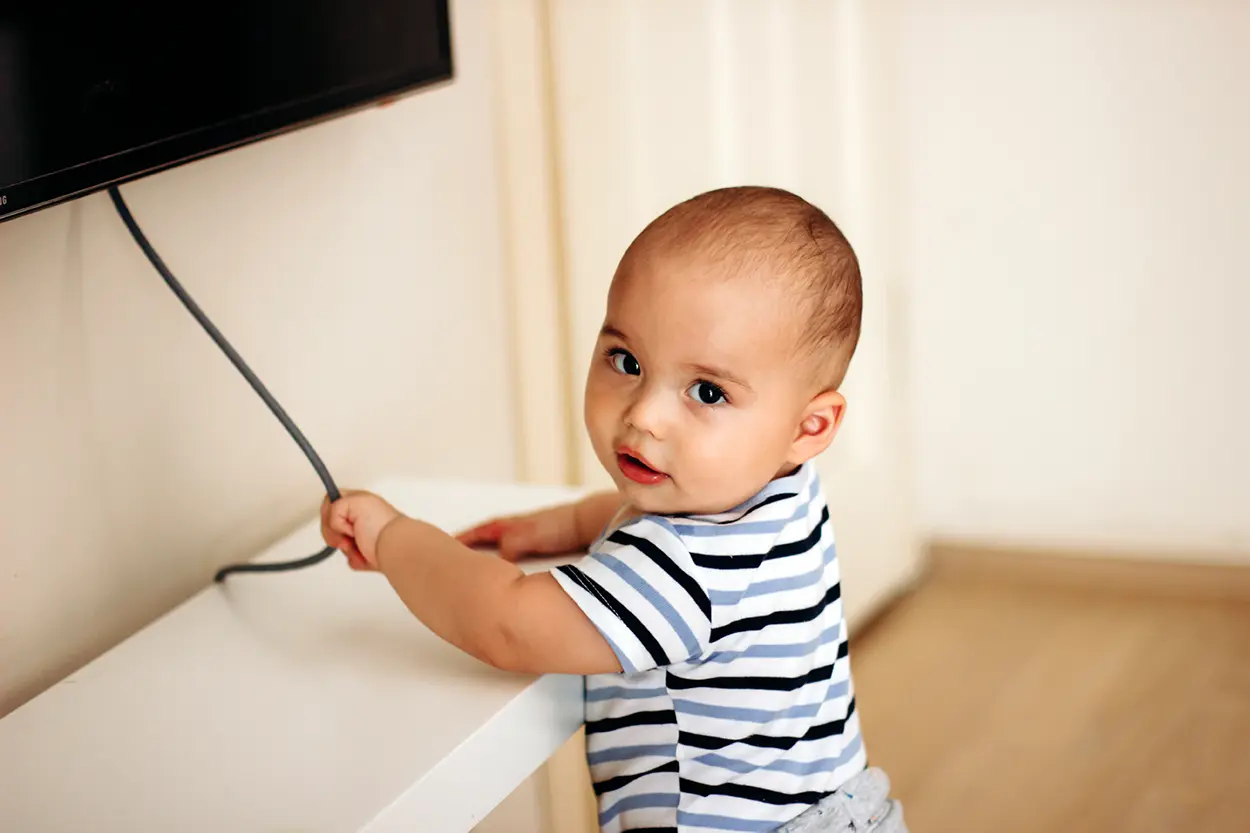
Loose electrical cords are both a strangulation hazard and a chewing hazard. Tuck power cords behind furniture where possible, use cord shorteners or winders to eliminate excess length, and run cords along walls with cord management clips rather than across open floor areas. Window blind cords are a significant strangulation risk — the U.S. Consumer Product Safety Commission has issued repeated safety warnings about corded window coverings and recommends cordless window coverings in rooms where children sleep or play.
Furniture Tip-Over Prevention
Tall furniture — bookshelves, dressers, wardrobes, TV stands — can tip forward when a child grabs the front and pulls or climbs. Furniture tip-over incidents cause thousands of injuries and fatalities to children each year. Anti-tip straps anchor furniture directly to the wall studs and are inexpensive and straightforward to install. Anchor every tall piece of freestanding furniture in rooms where your baby will spend time. This includes dressers in the nursery, bookshelves in common areas, and television stands.
The U.S. Consumer Product Safety Commission’s Furniture Tip-Over Safety page includes installation guidance and incident statistics that illustrate why this step is particularly important.
Small Objects and Choking Hazards
Babies explore the world orally — they put everything in their mouths. Any object small enough to fit through a cardboard toilet paper tube is a potential choking hazard for a child under three years of age. This includes coins, button batteries, small toy parts, pen caps, jewelry, magnets, and game pieces. Conduct a floor-level scan of every room your baby will access, looking specifically for small objects at ground level.
Button batteries deserve special attention. They are found in remote controls, key fobs, hearing aids, and small electronics. If swallowed, a button battery can cause serious internal injury within two hours. Store devices with button batteries out of reach, and check that battery compartments have secure screw closures rather than simple friction-fit covers. A mistake I made the first time around was forgetting about the battery in our bathroom scale, which had a simple pop-off cover my toddler figured out faster than I did.
Room-by-Room Baby-Proofing Checklist
Living Room and Common Areas
- Cover or replace all electrical outlets within reach
- Manage all loose cords (electrical, phone chargers, TV cables)
- Replace corded window blinds with cordless versions
- Anchor tall bookshelves, entertainment centers, and television stands to the wall
- Add corner and edge protectors to coffee tables and hearths with sharp or hard edges
- Move small decorative objects, glass items, and breakables out of reach
- Place gates across stairway openings at both the top and the bottom
- Secure the fireplace with a freestanding gate or permanent hearth barrier
- Remove or secure floor plants — many houseplants are toxic if ingested
Kitchen
- Install cabinet locks on cabinets containing cleaning products, sharp utensils, plastic bags, and any items you do not want accessed
- Install stove knob covers or remove knobs when not in use
- Use back burners when possible and turn pot handles toward the back of the stove
- Move cleaning supplies from under the sink to a locked cabinet or high shelf
- Install a refrigerator lock if your baby or toddler is persistent enough to open it
- Secure the trash can with a child-resistant lid or move it to a locked cabinet
- Keep knives, scissors, and sharp tools in locked drawers or high out of reach
Bathrooms
- Install toilet seat locks — young children can fall headfirst into toilets
- Store all medications in locked cabinets, not in bathroom medicine cabinets accessible to children
- Keep all cleaning products, razors, and grooming tools out of reach
- Set your water heater to 120°F or below to prevent scalding burns
- Use a non-slip mat inside and outside the tub or shower
- Never leave a child unattended in a bath, even for a moment
Nursery and Bedroom
- Ensure the crib meets current CPSC safety standards — no drop-side rails, slats no more than 2⅜ inches apart, firm flat mattress that fits snugly
- Keep the crib clear of blankets, pillows, bumpers, and stuffed animals for infants under one year
- Position the crib away from windows, blinds, curtains, and monitor cords
- Anchor all dressers and furniture to the wall
- Install outlet covers in all reachable outlets
- Ensure the baby monitor cord is completely out of reach
Stairs and Doorways
- Install hardware-mounted safety gates at the top of all staircases — pressure-mounted gates are not safe at the top of stairs
- Install pressure-mounted gates at the bottom of stairs and in doorways you want to restrict
- Ensure gates meet current safety standards (look for JPMA certification)
- Check that gate spindles are narrow enough that a child’s head cannot fit through
Garage and Outdoor Areas
- Lock the door between the house and garage — garages contain numerous hazards including chemicals, tools, and vehicles
- Store all automotive products, pesticides, fertilizers, and power tools in locked cabinets
- Test the garage door auto-reverse mechanism regularly
- Check outdoor play areas for standing water, exposed nails, splinters, and unstable equipment
- If you have a pool, install a four-sided pool fence with a self-closing, self-latching gate that meets your local code requirements
Ongoing Safety Habits
Baby-proofing the physical environment is only part of the equation. Equally important are the daily habits that prevent accidents:
- Never leave a young child unattended in a room that has not been baby-proofed
- Return items to their safe locations after use — a medicine bottle left on the counter after use is as dangerous as one stored in an accessible cabinet
- Brief every caregiver, grandparent, and babysitter on the baby-proofing measures in place and the hazard areas
- Learn infant and child CPR and choking response — the American Red Cross offers in-person and online courses
- Post Poison Control’s number (1-800-222-1222 in the United States) in a visible location
A well-executed baby-proofing checklist does not eliminate every possible risk — it reduces the most significant ones to a manageable level and buys you time to intervene when your baby’s curiosity outpaces their judgment. The goal is not a perfectly sterile environment but a home where your baby can explore freely while you maintain meaningful control over the most consequential hazards.
Written by Kevin Alvarez, BloggedTopics Home & Family Editor. Last reviewed and updated August 24, 2026.
