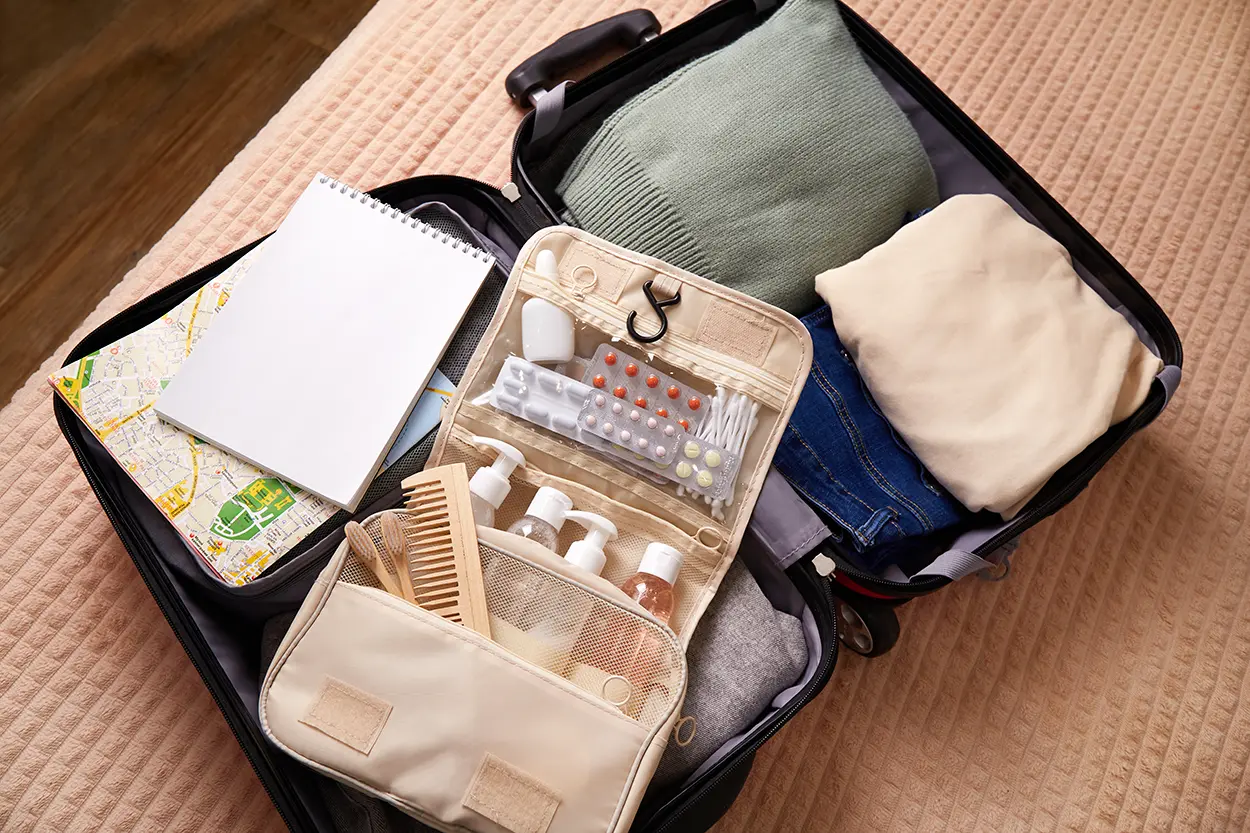
A three-day trip is short enough to manage comfortably with a single carry-on bag, but it is still surprisingly easy to overpack. The trick is to build your packing list around outfits, the actual weather forecast, and your real itinerary rather than throwing in items because you might theoretically need them. A lighter bag makes airports, hotels, public transportation, and exploring on foot noticeably easier. I didn’t fully believe this until I compared two nearly identical trips myself—the one where I packed light was noticeably less exhausting by day two, purely because I wasn’t hauling an overstuffed bag up and down subway stairs.
Check airline rules before packing a single item
Carry-on size and weight limits vary meaningfully between airlines, fare classes, and even specific routes. Before packing anything, check your airline’s baggage page and review the personal item allowance for your specific ticket type. Budget airlines in particular often have strict enforcement of size and weight limits that can result in unexpected gate-check fees if your bag is marginally too large.
If your trip involves airport security in the United States, the TSA’s liquids rule explanation covers the standard guidelines for liquids, gels, and aerosols in carry-on bags. Knowing these rules before you pack prevents the frustrating experience of having items confiscated at security. The TSA also maintains a searchable database of specific items to check whether something is permitted in carry-on or checked bags.
Pack around complete outfits
For most three-day trips, a practical clothing list includes two or three tops, one versatile bottom or extra bottom depending on activities, underwear and socks for each day plus one spare, sleepwear, a lightweight layer that works for both cool evening temperatures and air-conditioned indoor spaces, and one pair of comfortable shoes suitable for most activities on the trip.
Choose a neutral color palette where possible so tops and bottoms mix interchangeably rather than requiring specific combinations. Wear the bulkiest items, typically your heaviest shoes and jacket, while traveling rather than packing them. This saves significant bag space on the outbound journey.
If your trip includes a formal dinner, a beach day, and hiking, each activity may require slightly different clothing, which can push packing complexity higher. In those cases, look for pieces that serve double duty, such as a blazer that works over a casual top or trail shoes comfortable enough for casual walking on non-trail surfaces. A mistake I made on an early trip like this: I packed separate shoes for hiking, walking around town, and one dressier pair, and ended up wearing only two of the three the entire time—now I test in advance whether one pair can honestly cover two of my planned activities before I let it take up bag space.
Organize with small pouches
Divide your packing into distinct functional pouches rather than mixing everything loosely in the bag. A toiletries pouch, a chargers and cables pouch, a medications and first-aid pouch, and a documents pouch for boarding passes, IDs, and travel confirmations each serve a specific purpose and make retrieval fast without searching through the whole bag. Small packing cubes can compress clothing and keep outfits organized by day if that level of organization helps you.
Keep your most-needed items — phone charger, medications, travel documents, and any valuables — in your personal item bag or the most accessible outer pocket rather than buried in the main compartment. I’ve found that whatever pocket feels most convenient when packing at home is rarely the one I actually reach for at a security checkpoint, so I’ve started testing the retrieval, not just the packing, before I leave the house.
Leave extra space intentionally
Do not fill the carry-on completely on the outbound leg. You may bring back food, a small gift, a book, a souvenir, or simply laundry that packs less neatly than clean, freshly folded clothes. Extra space also makes repacking on the final morning much less stressful when you are tired and working against a checkout deadline.
After the trip: the packing review habit
When you return, spend two minutes noticing which items you never used. Common unused items include multiple pairs of backup shoes, formal clothing brought for a hypothetical scenario that did not occur, books read on the outbound flight and carried back unnecessarily, and redundant toiletries. Noting the unused items specifically makes future trips lighter without requiring any memory of the previous list.
Carry-on packing improves measurably with practice and reflection. Each trip teaches you something about your real needs versus your imagined needs, and the two gradually converge toward a lighter, better-calibrated approach.
Dealing with delays and rebooking
Carry-on travel is particularly practical in situations involving flight delays, cancellations, and missed connections, because your bag stays with you throughout any rebooking process rather than being potentially routed to a different destination than you. When delays occur and you need to rebook, the agent’s ability to put you on a different flight is not complicated by checked luggage logistics, giving you more flexibility in choosing the fastest available alternative routing.
Keep your essential items, medications, phone charger, and travel documents in the most accessible section of your bag rather than packed at the bottom. During long delays at airports, having quick access to these items without unpacking the whole bag makes the experience significantly more manageable. A personal item bag or backpack worn in front during transit is often the most accessible location for these essentials.
Carry-on packing for different climates and activities
Packing for a three-day trip to a cold destination requires different considerations than packing for a beach trip or a business trip. Cold weather clothing is bulkier and heavier per item than warm weather clothing, which may require choosing between a very compressed packing cube system and wearing the bulkiest items during travel. For beach trips, a lightweight microfiber towel packs far more efficiently than a standard bath towel. For business trips, wrinkle-resistant fabrics and a portable fabric steamer or access to hotel ironing facilities reduces the pack-and-present challenge.
Planning a carry-on trip to a destination with unpredictable weather involves accepting some trade-offs. Packing for all weather scenarios typically requires more clothes than a carry-on can hold comfortably. In that case, pack for the most likely conditions and plan for a single contingency item rather than trying to cover every possibility. Layers are generally the most flexible solution to weather uncertainty in a space-constrained bag.
Navigating airport security more efficiently
Carry-on travel makes airport security simpler in some ways and requires more attention in others. Liquids, gels, and aerosols over 3.4 ounces cannot go in carry-on bags, so checking TSA guidelines before packing toiletries prevents having items confiscated at the checkpoint. Prescription medications in quantities exceeding the standard liquid limit are generally permitted with documentation, but have the prescription label accessible rather than buried in the bag.
Using TSA PreCheck or Global Entry if you travel frequently simplifies the security experience by allowing you to leave shoes on, leave laptops in the bag, and move through a dedicated shorter line. The enrollment cost spreads across the number of trips taken during the membership period and becomes more worthwhile the more frequently you fly. For occasional travelers, the standard checkpoint process with a well-organized carry-on is entirely manageable without the additional program membership.
Written by Sarah Whitfield, BloggedTopics Travel & Lifestyle Editor. Last reviewed and updated August 20, 2026.
