How to Read Nutrition Labels: Why Learning the FDA Format Is Worth the Time
Knowing how to read nutrition labels is one of the most practical food literacy skills available to consumers, yet surveys consistently show that a significant portion of shoppers do not use nutrition labels or do not feel confident interpreting them. The Nutrition Facts label found on virtually all packaged food in the United States is governed by regulations from the Food and Drug Administration (FDA), which updated the label format in 2016 to reflect current scientific understanding of diet and health. Reading the label accurately — rather than relying on front-of-package marketing claims — gives you objective, standardized information about what you are actually eating. This guide explains each section of the Nutrition Facts label using the FDA’s own guidance, without making health claims or telling you what to eat.
The Official Source: FDA’s Nutrition Facts Label Guidance
The FDA’s Nutrition Facts label requirements are documented in detail in the agency’s public guidance materials and educational resources. The FDA’s guide to understanding the Nutrition Facts label is the definitive consumer reference for interpreting every section of the label accurately. Throughout this post, definitions and Daily Value references are drawn from that official FDA guidance.
The label is standardized: every manufacturer presenting a Nutrition Facts panel must follow the same format, making it possible to compare any two products on an equal basis.
Section 1: Serving Size and Servings Per Container
The most important — and most frequently overlooked — section of the Nutrition Facts label is the serving size and servings per container at the very top. Every number on the rest of the label refers to one serving, not the entire package.
Common misreading example: A bag of chips lists 150 calories per serving. The serving size is 1 ounce (about 11 chips). The bag contains approximately 3 servings. Eating the entire bag means consuming approximately 450 calories from that product — three times the per-serving figure.
Under the 2016 FDA label update, serving sizes were revised to more closely reflect the amounts people actually eat in one sitting, rather than the idealized small portions that appeared on older labels. This makes the serving size a more realistic reference point than it used to be, but it is still important to compare the stated serving size against the portion you are actually eating before reading the calorie count.
Section 2: Calories
Calories are a measure of energy. One food calorie (the unit used on food labels) is technically one kilocalorie — the amount of energy needed to raise the temperature of one kilogram of water by one degree Celsius. For practical purposes, the calorie count on a label tells you how much energy that serving provides.
The FDA’s guidance notes that 2,000 calories per day is used as a general reference for calorie needs on the Nutrition Facts label, but actual calorie needs vary significantly based on age, sex, body size, and activity level. The calorie count on a label is factual information — how you use it depends on your own dietary goals and the guidance of any healthcare professionals you work with.
Section 3: Nutrients — What to Limit and What to Ensure You Get
Below the calories, the label lists specific nutrients, organized into two conceptual groups by the FDA: nutrients many Americans consume in excess (associated with health risks when overconsumed) and nutrients many Americans do not get enough of (associated with health risks when underconsumed).
Nutrients to Be Aware of Consuming Too Much Of
- Total Fat: Reported in grams, with subcategories for Saturated Fat and Trans Fat broken out below. The FDA requires saturated fat and trans fat to be listed separately because dietary guidance distinguishes between fat types. Note that “0g Trans Fat” on a label can still mean up to 0.5g per serving due to rounding rules — check the ingredient list for “partially hydrogenated oils,” which indicates the presence of artificial trans fat.
- Sodium: Reported in milligrams. The Daily Value for sodium is 2,300 mg per day for the general population, per FDA guidance based on the Dietary Guidelines for Americans.
- Added Sugars: This line was added in the 2016 label update and is distinct from Total Sugars. Added Sugars refers to sugars added during processing — including cane sugar, corn syrup, honey, and other caloric sweeteners — distinct from naturally occurring sugars in fruit or dairy. The FDA notes that the Dietary Guidelines for Americans recommend keeping Added Sugars below 10 percent of daily calories.
Nutrients to Ensure Adequate Intake Of
- Dietary Fiber: Reported in grams. The Daily Value is 28g per day. Fiber is not produced by the human body and must come from food.
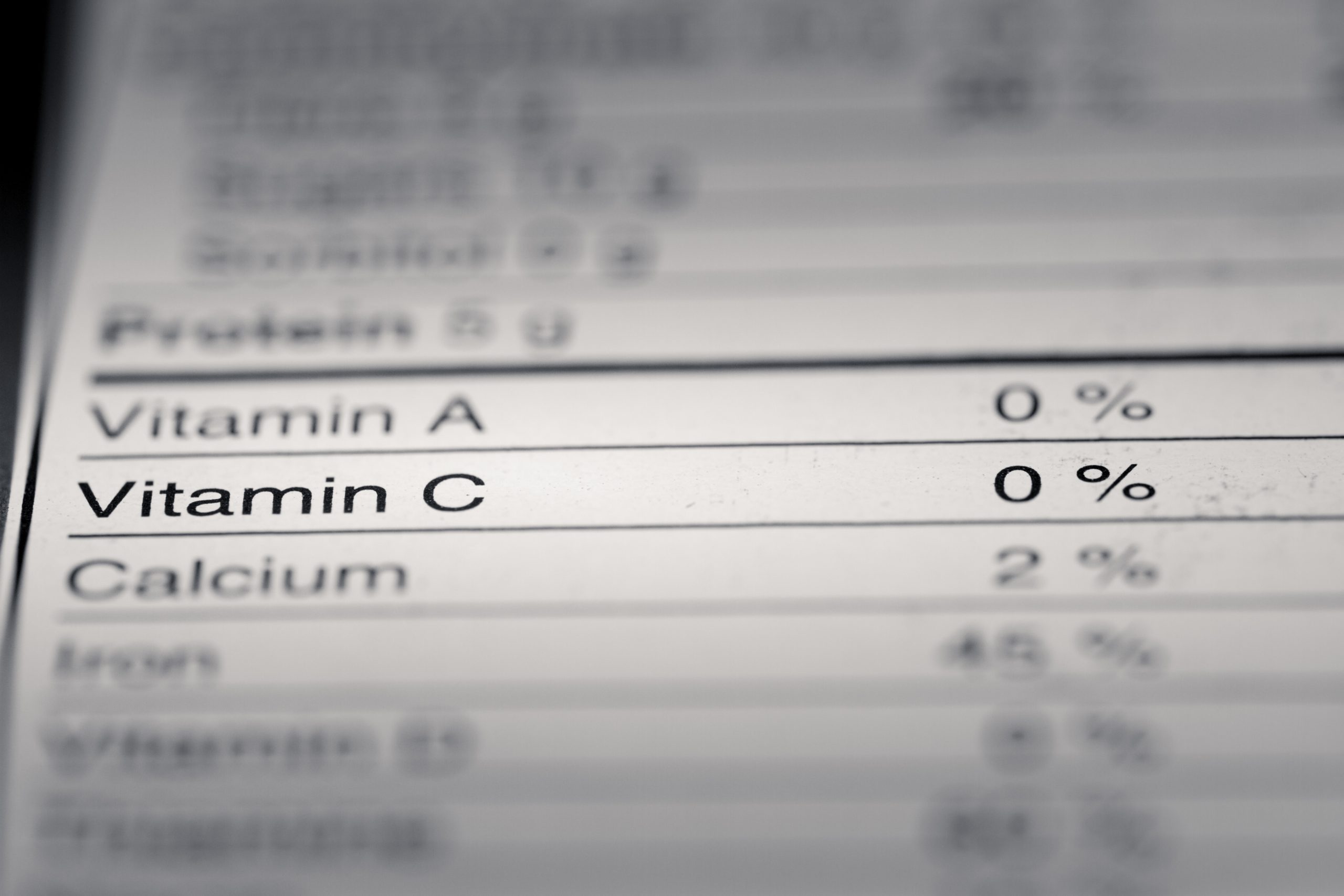
- Vitamin D: Added to the 2016 label update (replacing vitamins A and C, which were removed as required nutrients because deficiency is now less common). Reported as a percentage of the Daily Value.
- Calcium: Reported as a percentage of the Daily Value (1,300 mg per day).
- Iron: Reported as a percentage of the Daily Value (18 mg per day).
- Potassium: Added in the 2016 update. Reported as a percentage of the Daily Value (4,700 mg per day).
Section 4: Percent Daily Value (%DV)
The Percent Daily Value column is one of the most useful tools on the label for quick comparisons. It tells you what percentage of the recommended daily intake for each nutrient one serving provides, based on a 2,000-calorie reference diet.
The FDA offers a useful general interpretation guide:
- 5% DV or less is considered low for a nutrient per serving
- 20% DV or more is considered high for a nutrient per serving
This guideline applies to both nutrients you might want to get more of (fiber, calcium) and nutrients you might want to watch (sodium, saturated fat). For example:
- A food with 35% DV for sodium per serving is high in sodium.
- A food with 3% DV for fiber per serving is low in fiber.
The %DV column makes it possible to compare two products without doing any math — look at the %DV for the nutrients that matter to you and choose accordingly.
Section 5: The Ingredient List
The ingredient list appears below the Nutrition Facts panel. Ingredients are listed in order by weight, from most to least. The ingredient present in the greatest amount by weight appears first. This is standardized by FDA regulation.
Practical uses of the ingredient list:
- Allergen identification: The FDA requires the eight major food allergens (milk, eggs, fish, shellfish, tree nuts, peanuts, wheat, soybeans) to be declared on labels, either in the ingredient list or in a “Contains:” statement below it. Sesame was added as the ninth major allergen in 2023.
- Added sugar sources: There are more than 60 names for added sugars that may appear in an ingredient list. If multiple sugar types appear among the first several ingredients, the combined added sugar contribution may be higher than a single ingredient position suggests.
- Partially hydrogenated oils: As noted above, this phrase indicates artificial trans fat, even if the Nutrition Facts panel shows 0g trans fat per serving due to rounding.
Using the Label for Product Comparison
The Nutrition Facts label’s most practical everyday use is comparison shopping. When choosing between two similar products:
- Verify that the serving sizes are equivalent, or adjust mentally. If one product shows data for 1 cup and another for ½ cup, double the second product’s values to compare fairly.
- Identify the nutrients most relevant to your goals or dietary situation.
- Use the %DV column to rank the products quickly without mental math.
The FDA’s interactive label guide includes a visual breakdown of each section with plain-language explanations of every component — a useful companion resource for anyone building their label-reading fluency.
Front-of-Package Claims vs. the Nutrition Facts Label
Front-of-package marketing claims — “low fat,” “high protein,” “natural,” “made with whole grains,” “heart healthy” — are not regulated with the same standardization as the Nutrition Facts label. The FDA regulates specific nutrient content claims (a product must meet specific criteria to legally call itself “low fat” or “reduced sodium”), but general marketing language is not subject to the same precision requirements.
Reading the Nutrition Facts label and the ingredient list provides objective, standardized data. Front-of-package claims are marketing — they may be accurate as far as they go, but they rarely tell the complete nutritional story. A product labeled “fat-free” may be high in added sugar, for example. The label is always more informative than the front of the package.
Key Takeaways
- Always check the serving size first — every number on the label is per serving, not per package
- Use %DV as a quick reference: 5% or less = low; 20% or more = high
- Added Sugars is a distinct line item, separate from naturally occurring sugars
- The ingredient list is ordered by weight — the first ingredient is present in the greatest amount
- Check the ingredient list for partially hydrogenated oils if the trans fat line shows 0g
- Front-of-package claims are marketing; the Nutrition Facts panel is standardized regulatory information
 blogged